
Removals in Petts Wood, South East London
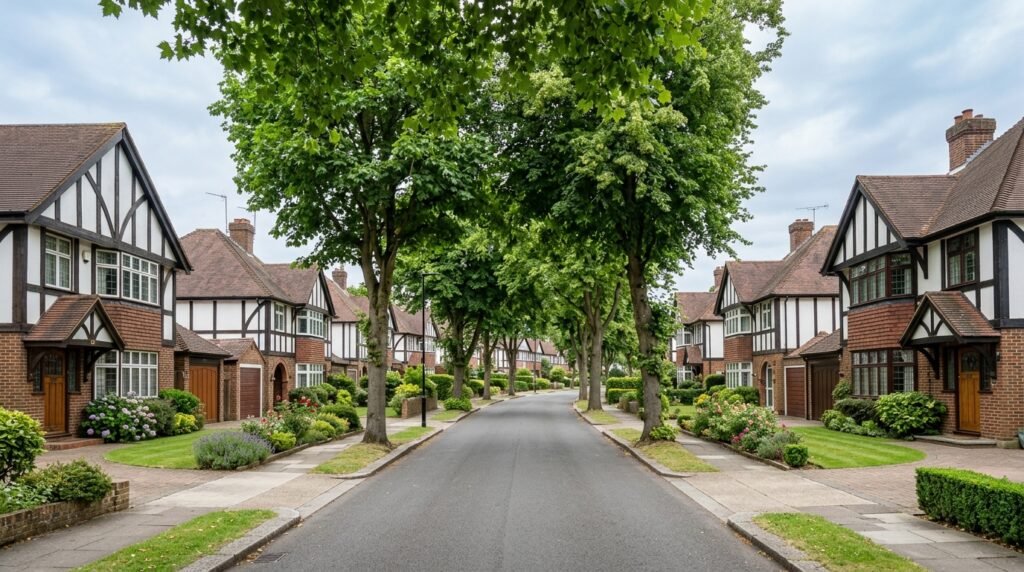
Petts Wood is the 1920s and 1930s Garden Suburb where Tudor revival houses still line every street. Originally planned by Basil Scruby with architect Leonard Culliford, the suburb was built by 45 builders working in Petts Wood East alone in 1930. Noel Rees designed distinctive houses that still command premiums. Davis Estates built the more standard semis. The Crofton schools (Ofsted Outstanding) draw families from across South East London. We handle moves into and out of all of it, original Tudor revival semis, extended Davis-builds, the rare new-build infill, and the prestige Noel Rees properties.
A Planned Garden Suburb from 1930
Petts Wood isn’t a suburb that grew organically, it was deliberately designed. In the 1920s and 1930s, Basil Scruby (with architect Leonard Culliford) laid out the masterplan for what they called the Petts Wood Garden Suburb. The masterplan defined the street pattern, the plot sizes, the building amenities, and the basic character of what would be built. The Estates Gazette reported in 1930 that 45 different builders were working in Petts Wood East alone, some building entire roads, others just a few houses, but all operating within the framework Scruby and Culliford had established. The result is a planned suburb with genuine architectural coherence rather than the random infill character common to most 1930s housing developments.
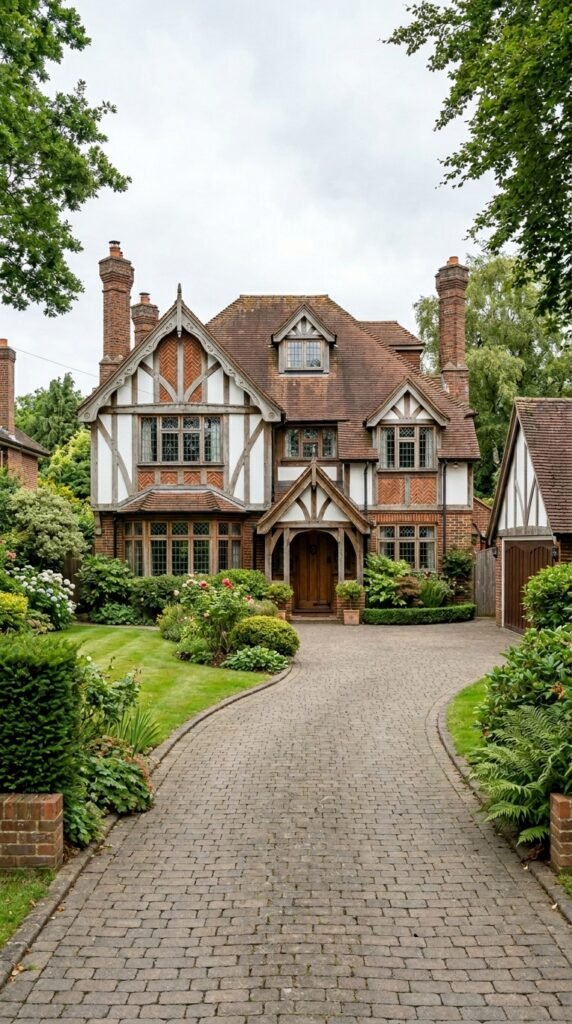
The dominant style was Neo Tudor revival, white-painted timber framing in the gables, leaded windows, decorative brickwork, hipped tiled roofs, and the overall ‘rural-romantic’ aesthetic that was fashionable in the inter-war years. Not every house followed this style strictly, and Davis Estates (one of the most prolific 1930s London builders) added their own variations. But the overall coherence of the suburb’s architectural character has survived nearly a century of subsequent alterations, extensions, and modern infill.
Today, parts of Petts Wood (particularly the eastern side, sometimes called Petts Wood East) fall within the extended Chislehurst Conservation Area. This affects what owners can alter externally on listed and characterful properties. The local council, the residents’ associations, and the conservation officers all take a strong interest in preserving the suburb’s character, which means new builds are rare (the recent £950K-£1M four-bedroom detached homes in Petts Wood East are notable exceptions) and most property changes happen through internal renovation rather than external alteration.
Petts Wood is part of our wider Bromley coverage area. If you’d like to see how we handle the rest of the borough, the parent page covers it.
Noel Rees, Davis, and the Tudor Revival
Within the Petts Wood Garden Suburb framework, two builder names come up repeatedly when local residents and estate agents describe properties. Noel Rees was a notable architect whose distinctive Tudor revival designs are still individually identifiable on certain streets, properties marketed as ‘Noel Rees houses’ command premiums because of the recognisable detailing, the original features, and the architectural pedigree. Davis Estates was the more prolific builder, responsible for hundreds of standard 1930s Davis-built semis throughout Petts Wood, in a similar but more uniform Neo Tudor style. Both architectural lineages remain visible across the suburb.
Standard Davis-built and similar semis
Three and four-bedroom 1930s semi-detached houses on streets like Tudor Way, Birchwood Road, and the surrounding residential roads. Davis-built and equivalent properties from the era, with the original Neo Tudor detailing (white-painted timber framing in the gables, leaded windows, hipped roofs). Some have been substantially extended over the years, side extensions, loft conversions, kitchen-diner rear extensions are all common. Properties needing updating still come to market at the lower end of this range; properties recently refurbished sit at the upper end. Move volumes are typical of family ownership patterns of 8-15 years.
Refurbished and extended period family homes
Larger four and five-bedroom semis and modest detached properties that have been substantially extended and refurbished. Some retain the original character (extension done sensitively in matching brickwork and detailing). Others have been more thoroughly modernised internally while keeping the external period look. The four-bedroom new-build detached homes in Petts Wood East (recent listings at £950K-£1M, chain-free, walking distance to Crofton schools) also sit in this bracket. Move volumes are higher than the standard semi tier, typically 3-4 full Luton loads.
Distinctive Noel Rees and prestige period properties
The most architecturally significant Petts Wood houses, substantial detached or semi-detached homes designed by Noel Rees, often retaining many original features (oak strip flooring, leaded windows, original fireplaces, panelled entrance halls, Tudor-style ceiling beams). Properties on Birchwood Road within the extended Chislehurst Conservation Area can reach the upper end of this bracket. These moves require heritage-property handling, floor runners on original oak flooring, careful protection of leaded windows and decorative woodwork, dismantling for narrower original doorways. Full-day moves with three or four crew.
The Crofton Catchment and the National Trust Edge
Two features beyond the architecture drive substantial Petts Wood demand. The first is the Crofton schools, Crofton Infants and Crofton Juniors, both consistently rated Outstanding by Ofsted and feeding into strong secondary options including Bromley High School (private girls’) and Bullers Wood. Families across South East London target the Crofton catchment specifically, and many Petts Wood moves are catchment-positioning families with primary-age children. The Year 6 Kent Test timing (which we covered in detail on the Orpington and Wilmington pages) applies here too, families plan completions to fall before the test in early September, with the May-August window being the peak.
The second feature is Petts Wood itself, the actual woodland that gave the suburb its name. Petts Wood is owned by the National Trust and Bromley Council combined, covering substantial ancient woodland that wraps around the eastern and northern edges of the residential suburb. Properties backing directly onto the wood (rare and premium) carry the woodland-adjacent characteristics we’ve seen at Joydens Wood: rear access constraints (the woodland boundary is solid, all loading goes through the front), narrower lanes on some woodland-edge streets, occasional wildlife considerations during nesting season, and the simple fact that residents specifically value the woodland walking access.
The combination of Outstanding schools, woodland edge, and distinctive architecture means Petts Wood property prices have remained robust through various market cycles. Long occupation patterns are common (12-18 years typical), and within-Petts-Wood upsize moves are nearly as common as moves to or from outside the area, families arrive in a smaller Davis semi as their first owned house, upsize within Petts Wood to a larger detached or Noel Rees property as the family grows, and sometimes downsize back to a smaller Petts Wood property after children have left home.
Move logistics for the woodland-edge properties: we send a 3.5-tonne short-wheelbase Luton rather than the 7.5-tonne for properties on the narrowest lanes immediately adjacent to the National Trust boundary. Capacity for a typical residential move is the same; the vehicle just suits the narrower lanes better. We assess on the specific property when quoting.
Petts Wood-Specific FAQs
My Petts Wood property is described as a ‘Noel Rees house’. Does that affect the move?
Yes, in the same way that other distinctive period property handling does. Noel Rees houses typically retain original features that need careful protection, oak strip ground-floor flooring, leaded windows (which catch on tall furniture being carried through), original fireplaces and surrounds, decorative panelled entrance halls, Tudor-style ceiling beams in some rooms (which catch on top-heavy items), and narrow original doorways in upper rooms. We use floor runners on every original floor, carry rather than wheel through panelled hallways, and dismantle furniture that won’t pass through original door widths. A move that would be a half-day in a modern equivalent property is usually a full day in a Noel Rees house, we build that time into the quote upfront, and our most experienced crew handles these properties.
What’s the William Willett connection to Petts Wood?
William Willett was the local builder and campaigner who proposed British Summer Time (BST) in 1907, the idea of moving the clocks forward in summer to make better use of daylight. Willett lived in nearby Chislehurst, but his daughter married into a family in the Petts Wood area, and the William Willett Memorial Sundial sits in a small clearing within Petts Wood (the actual woodland) commemorating his campaign. BST became law in 1916, the year after Willett’s death. The connection is mostly historical curiosity rather than something that affects daily life in the area, but locals are aware of it and the sundial is a known landmark. For removal purposes it doesn’t affect anything, we mention it because customers occasionally ask why the woodland is significant beyond just being woodland.
If I’m moving for the Crofton school catchment, what’s the realistic timeline?
Same pattern as the broader grammar school catchment moves we handle across Bromley and the surrounding Kent. The Crofton schools are primary schools (Infants and Juniors), so the catchment question is about getting into Reception (age 4-5) or moving in for Year 3 (entry to the Juniors). Reception admission decisions are made in April for September starts, so families typically need to be in the catchment by January-February of the relevant admission year. We see significant Petts Wood booking volume from October through February as families complete on purchases timed to be settled before primary admission decisions. We can absorb the demand but recommend booking 6-8 weeks ahead during this window if possible. For families positioning for the Year 6 Kent Test (similar to the wider South East London pattern), the same May-August summer-completion peak applies.
My property is on the woodland edge. Does that change the move?
Slightly, in two ways. First, the rear of the property is unreachable for the van, the woodland boundary is solid (fences, hedges, sometimes more substantial barriers). All loading and unloading goes through the front door, around the side of the house if there’s side access. Second, lanes immediately adjacent to the National Trust woodland boundary tend to be narrower than the standard Petts Wood streets, with overhanging tree canopy in places. We send a 3.5-tonne short-wheelbase Luton for the most direct woodland-edge properties, same total capacity for a typical residential move, just better suited to the lanes. Capacity-wise, nothing changes; logistics-wise, we plan the right vehicle for the specific access conditions.
Moving In or Out of Petts Wood?
Send us your postcode, the property style (Davis semi, Noel Rees, modern new-build, or one of the other variants), and a quick note on whether you’re in Petts Wood East or central Petts Wood. We’ll come back with a quote that accounts for the period detail and the realistic time needed. Usually within an hour during working hours.