
Removals in New Addington, East Croydon
New Addington started in 1935 as Charles Boot’s vision for a Garden Village of 4,400 houses on 569 acres of former Fisher’s Farm. Construction ran from 1935 to 1963. For 65 years the estate was genuinely isolated, nicknamed Little Siberia for both its hilltop chill and its distance from Croydon proper. Then Tramlink Route 3 arrived in 2000 and connected New Addington to Croydon and Wimbledon in about 25 minutes. Today the estate has affordable semi-detached homes from £200K, four bus routes through the centre, and a community pulled into the wider London network.
Charles Boot’s 1935 Garden Village
New Addington’s story starts in 1935 with the First National Housing Trust under chairman Charles Boot. The Trust purchased 569 acres of Fisher’s Farm with the explicit intention of building a Garden Village, modelled on the early 20th-century garden suburb movement. The masterplan called for 4,400 houses, shops, two churches, a cinema, and a village green, with the estate designed to provide quality housing for working families at a time when much of London was overcrowded and slum-clearance pressures were building.
Construction proceeded quickly. By 1939, when the outbreak of World War II suspended building, 1,023 houses and 23 shops had been completed. The earliest part of the estate is still known locally as ‘The Boot’s Estate’ after Charles Boot himself, who wanted the development to ‘uplift the spirit of its people’ by raising quality of life beyond what slum housing could offer.
Construction resumed after the war, with Croydon Corporation taking over development from 1963 onwards. The Fieldway estate to the north of King Henry’s Drive was completed in subsequent decades, finishing around 1968. The completed estate covered most of the original 569 acres, though some of the planned amenities (the second church, the cinema, the larger village green) never materialised as the original Garden Village ambitions were scaled back in the post-war period.
New Addington is part of our wider Croydon coverage area. If you’d like to see how we handle the rest of the borough, the parent page covers it.
Tramlink Route 3 and the End of Isolation
For 65 years, from the estate’s beginnings in 1935 through to 2000, New Addington was genuinely isolated from the wider Croydon area. The estate sits on a hill between Addington Vale to the east and the valley west of the modern tram line, surrounded by green belt land that limited expansion of road connections. For employment, decent shopping, and a wider range of schools, residents had to travel substantial distances by bus, with patchy services that made daily life difficult. The estate earned the nickname ‘Little Siberia’ for both the genuine chill of its hilltop location (noticeably colder than the rest of Croydon, particularly in winter) and the feeling of distance from the wider city.
Tramlink Route 3 opens, 2000
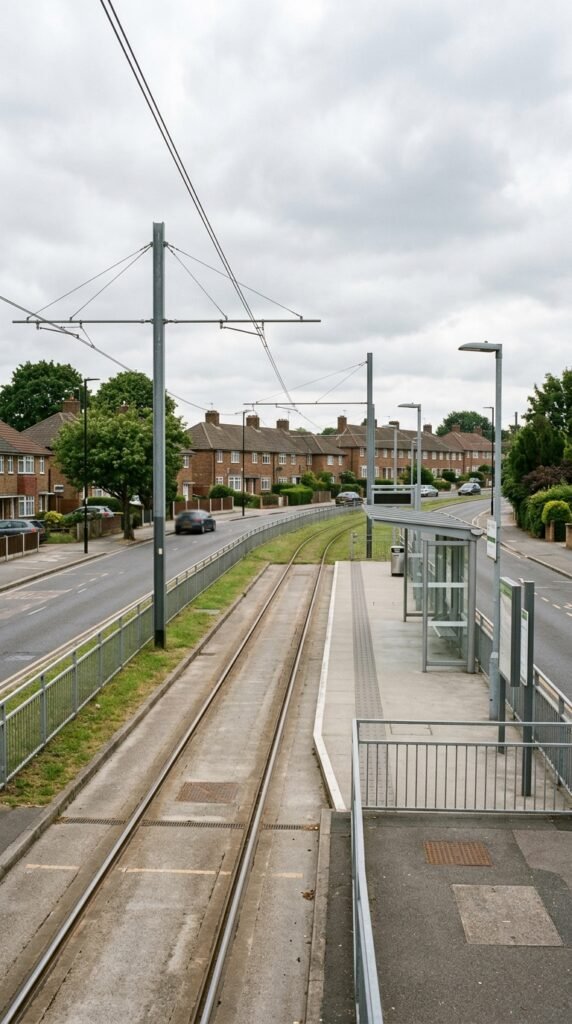
The arrival of Tramlink Route 3 in 2000 transformed New Addington’s connectivity. The tram runs from the New Addington terminus at the end of Parkway, through King Henry’s Drive, Fieldway, and Addington Village interchange, then over the Addington Hills to Sandilands and on into central Croydon. Journey time from New Addington terminus to East Croydon is around 20-25 minutes. From East Croydon, mainline rail connects to London Bridge in 17 minutes, Victoria in 18, Gatwick in 15. The combined journey from New Addington to central London is therefore roughly 40-55 minutes door to door, comparable to many outer London suburbs.
Bus network expansion
Tramlink’s arrival came with significant expansion of feeder bus services. Four bus routes now run through New Addington’s central area, including one 24-hour service. Buses connect to surrounding areas (Shirley, Selsdon, central Croydon) and to the Tramlink network itself, giving residents practical alternatives for journeys not well-served by the tram. The Education Action Zone designation that came with the regeneration also brought additional school investment in the area.
Central Parade and Fieldway
The estate’s commercial centre at Central Parade hosts a market and various eateries serving the local community. Fieldway, the slightly later part of the estate to the north of King Henry’s Drive, also has its own local services. Recent regeneration includes Octagon Cyber Café opened by Croydon Council, and the redevelopment of the former Cunningham pub site for a Lidl store that opened in early 2011. Tesco previously operated a supermarket in the area but has since closed.
Uniform Crescents and the Move Logistics
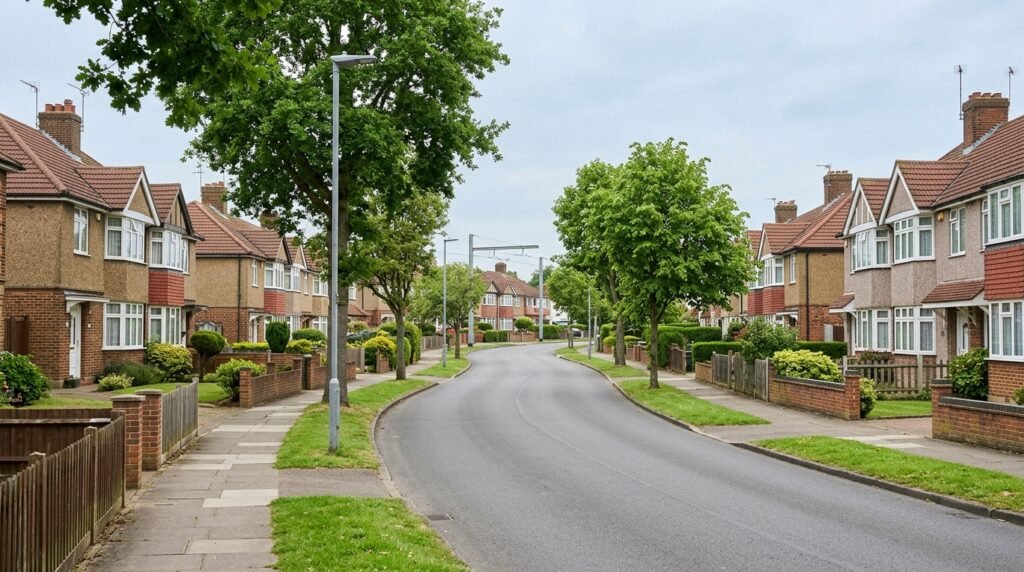
The housing across New Addington was built to a deliberate uniform standard, primarily semi-detached houses arranged on a series of crescents radiating outward from Central Parade. The crescent layout was an architectural choice typical of mid-20th-century social housing planning, providing curved street patterns that broke up the rigid grid pattern of older Victorian terrace development.
Property tier, semi-detached entry homes
Three-bedroom semi-detached houses across the original Boot’s Estate and the post-war Croydon Corporation builds. Consistent semi-detached form, consistent plot size, minimal architectural decoration. Most properties have a front garden, a rear garden, and an attached or detached garage to the side. Move logistics are conventional, straightforward access to most properties, wide enough streets for standard 7.5-tonne Luton vans. Some streets within Fieldway are narrower and we send a 3.5-tonne short-wheelbase van for properties on those particular roads.
Property tier, extended family homes
Many original semis have been substantially extended over the decades, often through Right-to-Buy ownership cycles and subsequent owner-occupier improvements: side extensions, loft conversions, kitchen-diner rear extensions, conservatories. Properties extended this way often have 4-5 bedrooms effective floor space, larger volumes than the original three-bedroom semi suggests. We measure on the actual property when quoting rather than relying on the original house-type. Move volumes typically 2-3 Luton loads for the larger extended family homes.
Parking on crescent layouts
The original estate plan provided less off-street parking than equivalent privately-built post-war estates, partly because car ownership in 1935 was much lower than today. Many New Addington streets have substantial on-street parking pressure, particularly in the evenings and weekends. We coordinate with you on the move day to identify suitable van parking, sometimes immediately outside the property, sometimes a short carrying distance away. For move days when parking is genuinely difficult, we can arrange a temporary parking suspension through Croydon Council (£30-50 cost, charged at our cost) to guarantee access.
Move volumes and long-occupation patterns
New Addington has a high proportion of long-occupation owners, families that bought through Right-to-Buy in the 1980s-90s and have owned since, plus the original Council tenants who never bought. This means substantial accumulated possessions for many moves out of the estate. Standard New Addington semi-detached moves run 1.5-3 Luton loads depending on how long the property has been occupied. We bring appropriate crew sizes for the realistic volume.
New Addington-Specific FAQs
Tramlink Route 3 runs through New Addington. Does that affect move logistics?
Not directly. The Tramlink runs in dedicated track alignment alongside Lodge Lane and through the central reservation of Parkway, separated from the road traffic. Trams don’t block road access at any point we’d need to use. Where Tramlink crosses roads at level crossings (Kent Gate Way is the main one), the crossings are signalled and the wait for a passing tram is typically under 30 seconds. The tram has minimal practical impact on move-day vehicle movement. The streets immediately around the New Addington terminus stop at the end of Parkway can have slightly heavier foot traffic from tram passengers, but it’s not significant enough to affect loading or unloading.
What’s the difference between Fieldway and the rest of New Addington?
Fieldway is the later, slightly more compact part of the estate built north of King Henry’s Drive in subsequent decades after the original Boot’s Estate. The housing form is similar (semi-detached, modest decoration, minimal plot sizes) but plots can be slightly tighter and the streets slightly narrower. Customer profile is similar to the rest of New Addington, established families and first-time buyers. For removal purposes, Fieldway moves sometimes use a 3.5-tonne short-wheelbase Luton instead of the 7.5-tonne because of the tighter streets, but capacity for typical residential moves is the same.
My New Addington street layout is a uniform crescent. Does that affect access?
Usually only marginally. The crescent layout means streets curve continuously rather than going in straight lines, which can make it harder to see a parking spot from a distance and slightly affects how we position the van. Most New Addington crescents are wide enough for our standard vans without issue, with the parking pressure being the bigger consideration than the curve itself. We assess on the specific street when quoting.
Is New Addington really colder than the rest of Croydon?
Yes, noticeably. The estate sits on a hilltop between Addington Vale to the east and the valley containing the Tramlink to the west, which means it’s exposed to wind on multiple sides. Average temperatures are typically 1-2 degrees cooler than central Croydon at street level, and the wind can make it feel colder still. For move purposes this doesn’t change anything, we work in all weather, but customers moving into New Addington from inner Croydon sometimes find their first winter colder than expected. Worth knowing if you’re moving up here in October or November and haven’t experienced a hilltop South London winter yet.
Moving In or Out of New Addington?
Send us your postcode (CR0 0 or CR0 9), the property type, and let us know if you’re in Fieldway or the main estate. We’ll come back with a quote that accounts for the realistic time and any access considerations. Usually within an hour during working hours.