
Removals in Mottingham, South East London
Mottingham is the SE9 neighbourhood first recorded in AD 862 as ‘the proud place’, a farming village that became a 2,000-home London County Council estate in the 1930s. It sits where the Greenwich, Bromley, and Bexley boundaries meet, carries real heritage in Eltham College and the old Porcupine Inn site, and offers genuinely affordable family homes by London standards. Prices run from around £225K flats to £650K extended family semis. Mottingham station connects to central London and Dartford. We handle moves across the whole area.
The Proud Place, From AD 862 to the LCC Estate
Mottingham has the longest recorded history of anywhere in the Eltham area. It was first noted in AD 862 as Modingahema, a name sometimes interpreted as ‘the proud place’, and the village sign still carries that 862 date alongside a reference to Eltham College and to the cricketer W. G. Grace. For most of its history it was a farming hamlet centred on Mottingham Lane, with a few large houses including Fairy Hall, which was rebuilt in 1856 and, by 1912, had become Eltham College, the well-known independent school that still sits at the heart of the area.
Development came in stages. Mottingham station opened in 1866 (oddly, it was first named Eltham, since there was no significant settlement here to name it after). Cottages went up along what is now Mottingham Road, with the small parade of shops known as the Terrace, and in the 1880s the West Park estate brought middle-class housing, along with St Andrew’s Church built in the fields between the station and the village. The big transformation followed the opening of the Sidcup arterial road in 1923, which prompted the London County Council to build the Mottingham Estate on the former Court Farm: around 2,000 houses, with schools and shops, first occupied from 1935.
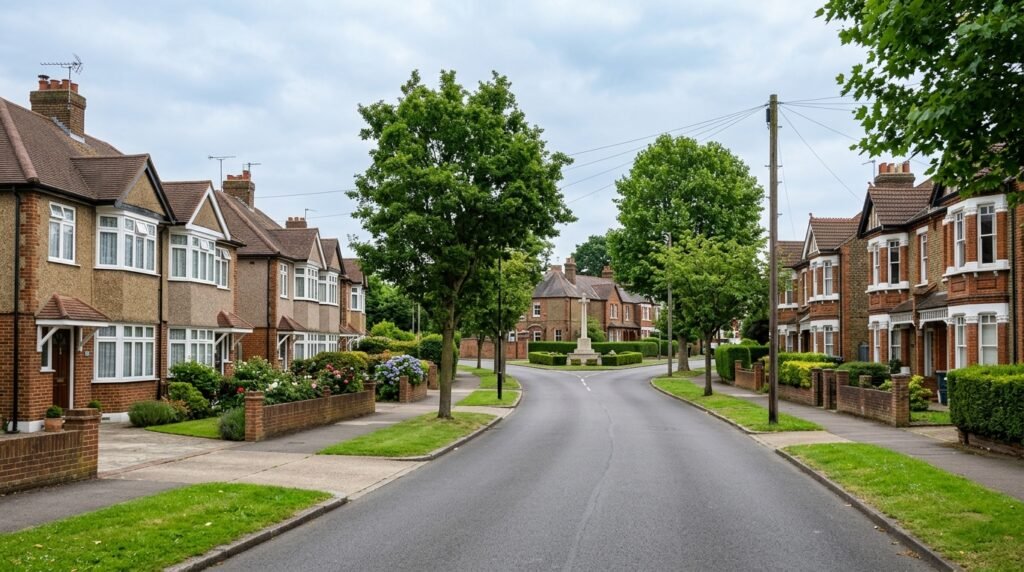
That history is why Mottingham today feels like two places stitched together. There is the older village core near the war memorial, where the Porcupine Inn stood (licensed since 1688, closed in 2013, the site now a Lidl after a long planning battle), with its period houses and traditional feel. And there is the much larger 1930s LCC estate spreading out around it, with its uniform semi-detached and terraced family housing. For a removals company, knowing which of the two you are moving in is the starting point for planning the day.
Mottingham is part of our wider Eltham coverage area. If you’d like to see how we handle the rest of SE9 and the surrounding patch, the parent page covers it.
Where Three Boroughs Meet: Property Tiers
Mottingham sits at an unusual administrative crossroads, with the Greenwich, Bromley, and Bexley boundaries all converging in and around the area. It makes no difference to a move, but it does mean the housing draws buyers and renters from all three directions. Three broad property tiers operate.
Apartments and entry tier
One, two, and three-bedroom flats and maisonettes, including the West Park apartment blocks (such as Pickwick Court) within walking distance of Mottingham station, plus ground-floor flats with balconies on the estate. Genuinely affordable entry points by London standards, popular with first-time buyers and buy-to-let investors drawn by the strong rental yields. Move logistics are typical flat moves, half-day to short full-day jobs, with lift or stair considerations in the blocks.
Estate family homes
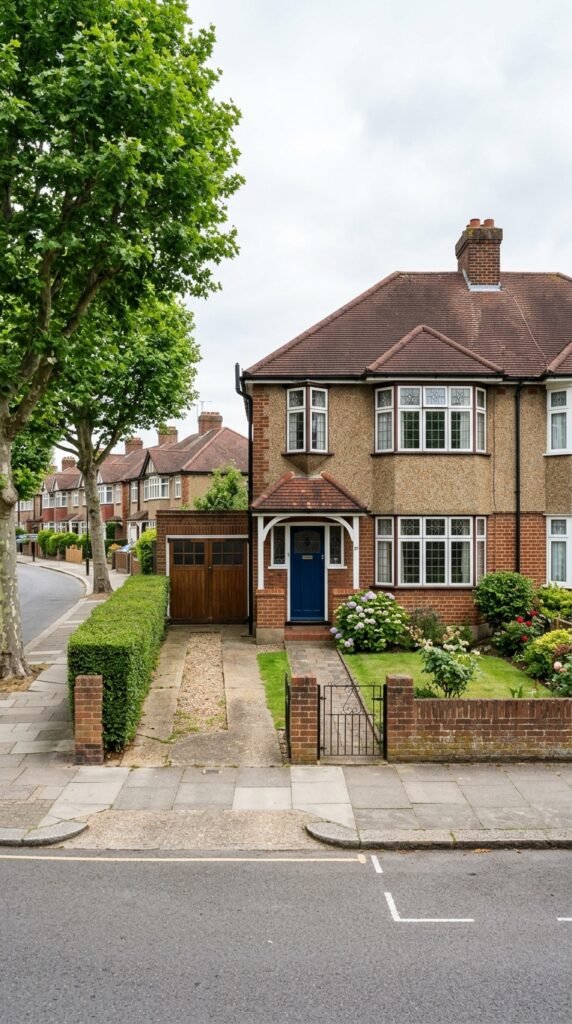
Two, three, and four-bedroom terraced and semi-detached houses across the LCC Mottingham Estate, on streets like Castleton Road, Middle Park Avenue, Bilsby Grove, and Clayhill Crescent. Many have garages, driveways, and westerly-facing gardens. Standard family ownership and a steady buy-to-let presence. Full-day moves with two or three crew typical.
Village and extended family homes
Larger, often extended semi-detached and detached family homes in and around Mottingham village and the more sought-after roads (Grove Park Road, Porcupine Close), some recently renovated, some character period properties. Extended four-bedroom homes reach the upper end. Long ownership is common, producing substantial move volumes. Full-day-plus jobs with three or four crew.
Village, Estate, and the Move Logistics
Mottingham moves split between the old-village properties, the LCC estate streets, and the apartment blocks near the station. Each has its own practical considerations, and the estate layout in particular has a couple of quirks worth knowing.
Estate street access
The 1930s LCC estate streets are mostly wide and well-laid-out, with grass verges and room for a standard 7.5-tonne Luton van. A few of the cul-de-sacs and closes (Highcombe Close, Clayhill Crescent and similar) have tighter turning circles, and for those we sometimes bring a 3.5-tonne short-wheelbase van for an easier approach, with the same capacity for a typical move. Most estate homes have driveways and garages, which gives good off-street loading space close to the front door.
Village and period-home handling
The older village properties near the war memorial and on Mottingham Lane include period homes with original features that need heritage handling: floor protection, careful carrying, dismantling for original door widths and narrower staircases. The larger character homes are substantial jobs with significant volumes, often from long ownership. We bring the right crew size and approach for the specific property.
Apartment and station-area moves
The flats and maisonettes near Mottingham station (the West Park blocks and similar) have the standard apartment-move considerations of lift access or stairs, which we plan crew numbers around. Streets immediately around the station can have tighter parking during weekday commuter peaks, and we time loading to avoid 7:00-9:30am and 5:00-7:00pm where a property sits close to the station. Parking suspensions are available where a guaranteed loading spot is needed.
School-run timing around Eltham College
Eltham College and the local primary and secondary schools generate predictable traffic at school-run times (roughly 8:00-9:00am and 3:00-4:00pm on term-time weekdays), particularly on the roads around the College and the main routes through the village. We schedule loading to start either side of those windows where a property sits on a school-run route, which keeps the van moving and the day on track.
Mottingham-Specific FAQs
Mottingham sits across three boroughs. Does that affect my move?
Not in any practical way. The Greenwich, Bromley, and Bexley boundaries all converge around Mottingham, which can genuinely confuse residents about which council they pay, which planning department to contact, or which borough’s services apply. But for a removal, the boundary makes no difference at all: we cover the whole area as one patch, with the same hourly rates and crew rates wherever the line happens to fall. The only time the boundary is worth checking is if you need a parking suspension for the move, since that is arranged through whichever council the specific street falls under, and we will confirm the right one when we set it up for you.
My Mottingham home is on the 1930s LCC estate. Is access straightforward?
Mostly yes. The Mottingham Estate streets are generally wide and well-planned, with grass verges and room for a standard 7.5-tonne Luton van, and most homes have driveways and garages that give good off-street loading space near the front door. The exceptions are a few of the tighter cul-de-sacs and closes, where we may bring a 3.5-tonne short-wheelbase van for an easier turning circle, with the same capacity for a typical move. If you tell us your street when you book, we will know whether the full-size van fits or whether the smaller one is the better call.
What’s the difference between Mottingham village and the estate?
Age and character. Mottingham village is the older core near the war memorial, on and around Mottingham Lane, with period houses, traditional buildings, and the heritage of the Porcupine Inn site and Eltham College nearby. The estate is the much larger 1930s London County Council development that spread out around the village, with uniform semi-detached and terraced family housing on wider, planned streets. For a move, the village period homes often need heritage-property handling (floor protection, careful carrying, original door widths), while the estate homes are conventional modern moves with good driveway access. We bring the right approach for whichever part of Mottingham your property is in.
Is Eltham College a problem for moves nearby?
Only at school-run times, and only on the roads right around it. Eltham College and the local schools create predictable traffic at roughly 8:00-9:00am and 3:00-4:00pm on term-time weekdays, particularly on the routes near the College and through the village. We schedule loading on those roads to start either side of the school-run windows, which keeps the van moving and avoids the congestion. Outside term time, or for properties away from the College, it is not a consideration. As with any move, we plan the timing around the specific street so the day runs smoothly.
Moving In or Out of Mottingham?
Send us your postcode, the property type, and let us know whether you’re in the village or out on the estate, and which street, so we can plan the right van and access. We’ll come back with a quote that fits the job. Usually within an hour during working hours.