
Removals in Hayes village, Bromley borough
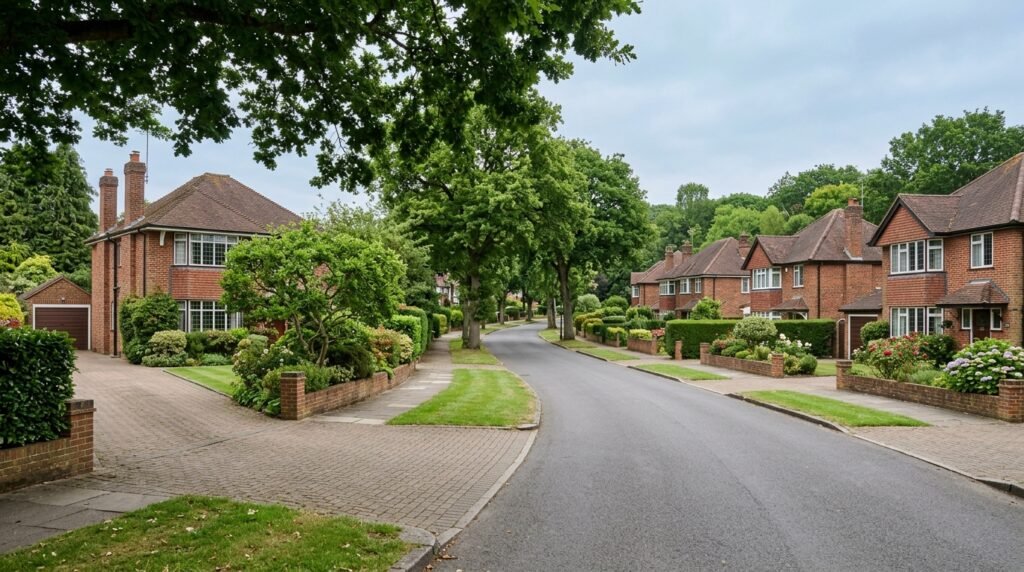
Hayes is the BR2 leafy village wrapped in parks, Hayes Common, Norman Park, Pickhurst Park, Pickhurst Recreation Ground, Husseywell Park all sit within walking distance of the residential streets. Not to be confused with Hayes in West London (Hillingdon, UB3), that’s 25 miles away, in a completely different part of the city. The Hayes we cover has substantial 1930s detached and semi-detached family homes on generous plots, strong school catchments (Hayes School, Hayes Primary, Pickhurst Academy), and properties from £485K modest semis to £1.4M-plus premium detached. We move people in and out of all of it.
Which Hayes We’re Talking About
Worth clearing up at the top of the page because the confusion is genuine and common. There are two Hayeses in Greater London. The one we cover is in the London Borough of Bromley, postcode BR2 7, a leafy village character settlement on the southern edge of the borough. The other Hayes is in the London Borough of Hillingdon, postcode UB3 and UB4, a substantially different area in West London near Heathrow, different demographic, different property market, different character entirely. The two are 25 to 30 miles apart depending on the route. Removal firms based in West London cover Hillingdon Hayes; we cover Bromley Hayes.
Royal Mail addresses for our Hayes include ‘Hayes, Kent’ or ‘Hayes, Bromley, Kent’ as historical convention, even though the area is administratively in Greater London rather than Kent. This is a leftover of the postal sorting system from before borough boundaries were finalised. The ‘Kent’ element of the address sometimes causes additional confusion, people moving from outside the area occasionally assume they’re moving to Kent rather than London, which can affect their council tax expectations and other administrative arrangements. Practically for the move itself, none of this matters; we cover all of it as Bromley borough.
In administrative terms: Hayes is in the London Borough of Bromley, with the council, MP (Beckenham constituency), and police force (Metropolitan Police) all being Greater London entities. The Hayes that’s in Hillingdon is a separate borough with separate everything. If you’re moving here from outside the immediate area, mention ‘Hayes Bromley’ or ‘Hayes BR2’ to anyone you’re coordinating with, that prevents confusion with the Hillingdon Hayes.
Hayes is part of our wider Bromley coverage area. If you’d like to see how we handle the rest of the borough, the parent page covers it.
A Village Wrapped in Parks
Hayes village’s defining feature is the sheer density of green space surrounding the residential streets. Hayes Common, substantial open common land at the village’s western edge, provides direct walking access for properties on West Common Road and the connecting streets. Norman Park to the north offers playing fields and woodland. Pickhurst Park, Pickhurst Recreation Ground, and Husseywell Park provide additional green pockets throughout the village. The cumulative effect is that almost no Hayes residential street is more than a 10-minute walk from substantial parkland. Multiple properties back directly onto Hayes Common or Norman Park , these command particular premiums.
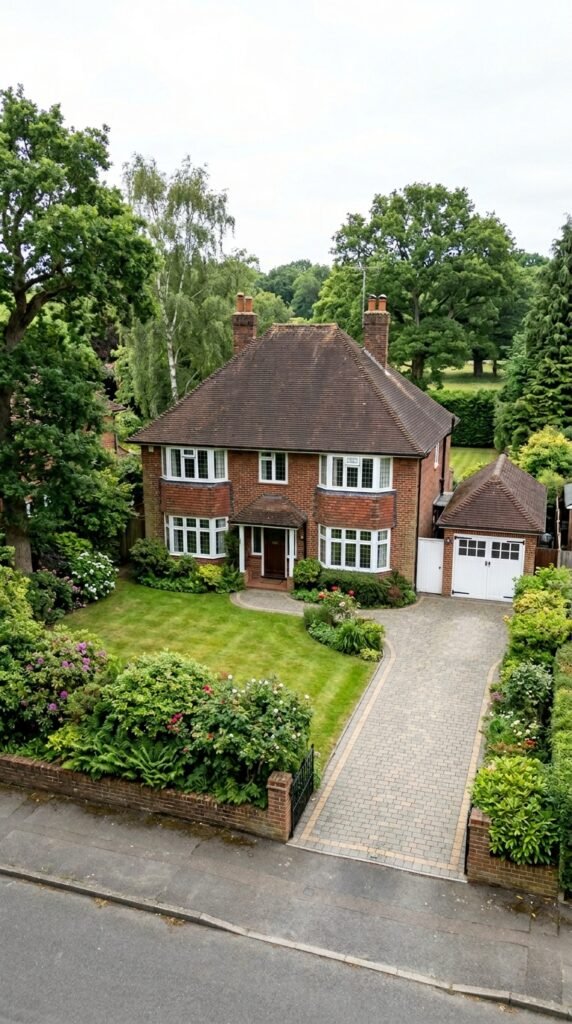
Entry tier: modest semis and apartments (£485K to £650K)
Three-bedroom 1930s semi-detached houses on the smaller streets, retirement flats in Forge Close area, and the modest residential properties at the edges of the village. The entry point to the Hayes market for first-time buyers and downsizers. Properties typically 100-120 sq m floor area, smaller gardens, sometimes needing modernisation. Half-day or full-day moves with two or three crew.
Standard family homes — 1930s detached and extended semis (£650K to £950K)
Four-bedroom 1930s detached and semi-detached houses on Pickhurst Lane, Pickhurst Mead, Ridgeway, Bourne Vale, Boughton Avenue, and the surrounding family streets. Many properties have been substantially extended over the years, side extensions, loft conversions, kitchen-diner rear extensions. The actual floor area can be 30-50% larger than the original 1930s footprint suggests, ranging from 1,400 to 2,000 sq ft after extensions. Standard family ownership patterns (10-18 years typical), substantial possessions. Full-day moves with three crew.
Premium detached and historic properties (£950K to £1.4M-plus)
Larger detached family residences on the prestige streets, substantial 5-bedroom properties around Pickhurst Lane (recent £1.2M-£1.25M listings), 5-bedroom 2,675 sq ft detached homes near Hayes Station and the high street, the character properties set behind gates on prime roads. Some genuinely historic houses include ‘Coachman’s Cottage’ on Pickhurst Lane (the historic home of William Pitt the Younger’s coachman, set behind cast iron gates, with gardens originally designed by William Pitts Sr. and Jr.) and ‘Deep End’ on West Common Road (direct access onto Hayes Common, electric gates). These are full-day-plus moves with four crew, careful packing requirements, and the discreet handling appropriate to high-value properties.
Schools, School Catchment, and Historic Houses
Two further features shape the Hayes property market in ways that affect how we plan moves. The first is the school catchment, which drives a substantial proportion of family demand. The second is the unusual concentration of properties with genuine historic significance, houses connected to notable figures and conservation-protected gardens, that exist in unusual density for a 20th-century suburb.
The Hayes school catchment
Hayes School (the secondary school on West Common Road) is consistently one of the strongest comprehensive secondaries in Bromley borough. Hayes Primary School and Pickhurst Academy (both Outstanding by Ofsted at various recent inspections) feed strongly into Hayes School and into the grammar schools across the wider borough (Newstead Wood, St Olave’s, Wilmington Grammar). Hawes Down Primary, Glebe, and Ravensbourne schools provide additional options. The result is that families across South East London target the Hayes catchment specifically, and many Hayes moves are catchment-positioning families. The Reception admission window (January-February for September starts) and the secondary admission window (October-November after Kent Test results) both produce booking peaks in our Hayes work.
Coachman’s Cottage and the historic properties
‘Coachman’s Cottage’ on Pickhurst Lane is the most distinctive of Hayes’s historic properties, the original coachman’s residence for the family of William Pitt the Younger (Prime Minister 1783-1801 and 1804-1806). The cottage sits behind cast iron gates with mature gardens that were originally designed and laid out by William Pitts Sr. and Jr. (the sculptor father and son, distinct from the political Pitts family). Recent listings have placed the property at around £895K. Other historic Hayes properties retain period detail, conservation-protected gardens, and the kind of careful preservation requirements that come with substantial age. We treat these with heritage-property handling: floor runners on original floors, careful protection of period features, dismantling for original door widths where needed.
Hayes Common direct-access properties
Several properties on West Common Road and the immediately surrounding streets back directly onto Hayes Common. These include ‘Deep End’ (a notable detached house with direct common access via electric gates) and various other family detached houses. Common-adjacent properties have the same logistical realities as woodland-adjacent properties elsewhere in our patch, the rear of the property is unreachable for the van (common boundary is solid), all loading goes through the front, and the lanes immediately adjacent to the common can be narrower than the standard Hayes streets. We send appropriate vehicle sizes.
Hayes Bromley-Specific FAQs
Is this Hayes the same as Hayes in West London?
BR2 7 postcode, on the southern edge of the borough, a leafy village character settlement with parks, 1930s detached houses, and good schools. The other Hayes is in the London Borough of Hillingdon, UB3 and UB4 postcodes, in West London near Heathrow Airport, completely different area, different demographic, different market. The two are about 25-30 miles apart depending on route. If you’re booking a removal, specify ‘Hayes Bromley’ or ‘Hayes BR2’ to avoid confusion. We cover BR2 7 Hayes; West London removal firms cover UB3/UB4 Hayes.
My Hayes property backs directly onto Hayes Common. Does that change the move?
Slightly, in the same way as other common-adjacent and woodland-adjacent properties in our patch. The rear of the property is unreachable for the van, the common boundary is solid (typically substantial hedging or fencing for security, with occasional access gates that are too narrow for vehicles). All loading goes through the front door and around the side of the house if there’s side access. Properties on West Common Road and the immediately adjacent streets can have narrower lanes than the standard Hayes residential streets, so we sometimes send a 3.5-tonne short-wheelbase Luton rather than the 7.5-tonne. Same total capacity for a typical residential move, just better suited to the lanes.
Pickhurst Lane has historic properties. How do you handle the older houses there?
With heritage-property handling. Properties like Coachman’s Cottage and the older houses on Pickhurst Lane include genuinely historic features, original brickwork, period windows, conservation-protected gardens, original layouts that have been preserved rather than modernised. We use floor runners on every original floor, carry rather than wheel through period spaces, dismantle furniture that won’t pass through original door widths, and bring multi-person teams sized for the careful work required. A move from a historic Pickhurst Lane property typically takes a full day rather than the half-day a modern equivalent might take, and we factor that into the quote upfront. Our most experienced crew handles these propertie
How does the Hayes School catchment affect move timing?
Standard catchment-driven peaks. For Hayes Primary and Pickhurst Academy (Reception admission for September starts), the timing peak is January-February completions as families want to be settled before the admissions deadline. For Hayes School and the grammar schools (secondary admission after Kent Test results), the peak is October-November completions for January starts at the secondary level, plus the wider summer-completion pattern (May-August) for families wanting to be settled before the new school year. We see Hayes booking volume rise during these windows and recommend booking 6-8 weeks ahead during peak times. Outside these windows, Hayes moves run at the same booking-lead-time as the rest of the borough.
Moving In or Out of Hayes (Bromley)?
Send us your postcode (BR2 7, not UB3/UB4!), the property type, and a quick note on whether you’re near a park or common, on Pickhurst Lane, or in one of the more central residential streets. We’ll come back with a quote that fits the property and the practical access realities. Usually within an hour during working hours.