
Removals in Joydens Wood, Kent
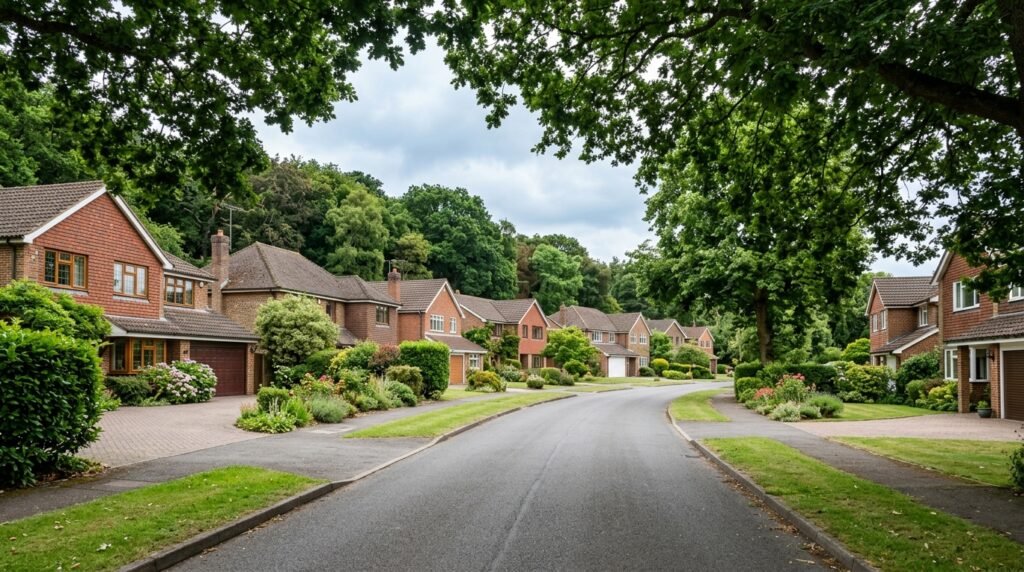
Joydens Wood is the urban village on the southern edge of Bexley, defined by direct adjacency to the woodland that gives it its name. Detached family homes on Birchwood Road and Hurst Road averaging £550K to over £1M. An 88% owner-occupied demographic, with families typically staying 15 to 25 years. We move people in and out of all of it, patiently, carefully, with the time built in for the volume that comes with long-occupied family homes.
An Urban Village Built Around a Wood
Joydens Wood sits on the southern edge of the London Borough of Bexley, bordering Dartford borough to the south. The actual woodland, Joydens Wood, a sizeable area of mature mixed deciduous woodland and nature reserve, gives the settlement its name and defines its character. Most residential properties in Joydens Wood are within a 10-minute walk of the woodland itself. Some properties back directly onto the wood, with private rear gates leading straight onto woodland paths.
The settlement is a 20th-century creation rather than a historic village. Most of the housing dates from the 1950s, 1960s, and 1970s, with later infill in the 1980s and 1990s. There’s no historic village core, no parish church, no high street as such. What there is, instead, is Joydens Wood Junior School (the primary school that anchors many family moves into the area), Joydens Wood Nature Reserve, and the surrounding wider amenities of Bexley village a mile north and Dartford a few miles south.
Estate agents describe Joydens Wood as an ‘urban village’, a phrase that captures the contradiction. It’s clearly urban (it’s in Greater London, surrounded by other suburban developments, with city infrastructure throughout). But it has a village feel that comes from the woodland, the predominantly detached housing on generous plots, the absence of through-traffic, and the long-occupation family demographic. People who live in Joydens Wood tend to know their neighbours by name and recognise each other’s cars.
Joydens Wood is part of our wider Dartford coverage area. If you’d like to see how we handle the rest of the patch, the parent page covers it.
The Stability That Woodland Attracts
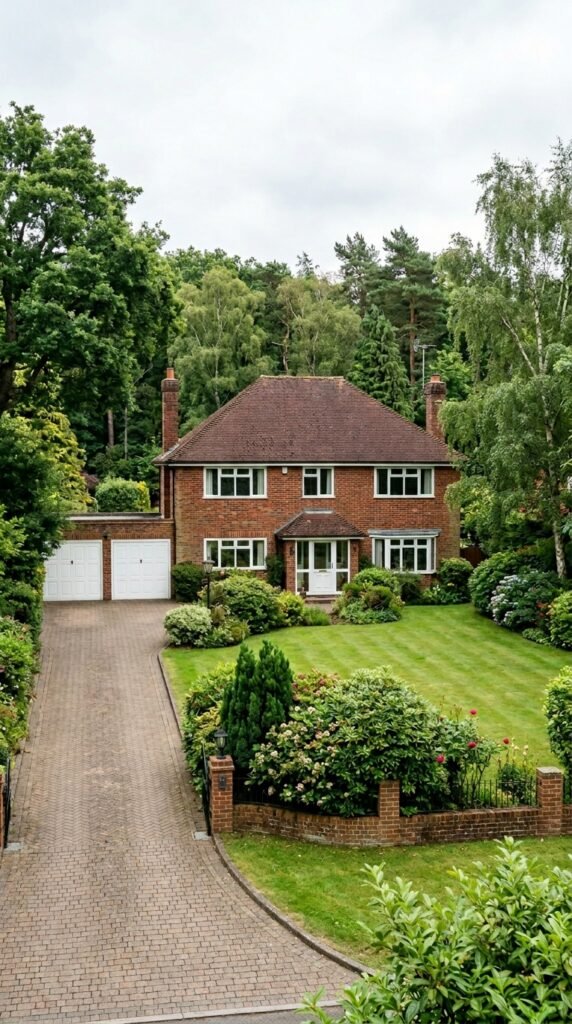
The Joydens Wood property market sits on numbers that are unusual for a suburban area this close to London. 88% of properties are owner-occupied, substantially higher than the Bexley borough average. 62% of properties sold are detached houses. almost double the regional average. Typical occupations run 15 to 25 years before properties come back to market. The combined effect is a market that turns over slowly and where, when properties do sell, they often go to buyers who plan to stay just as long
Mid-tier family homes (£450K to £650K)
Three and four-bedroom semi-detached and detached houses on the standard Joydens Wood streets, properties on Joydens Wood Road averaging around £555-627K, Woodside Drive at similar tiers, the connecting cul-de-sacs. Typical plot sizes are 30-50 feet wide with rear gardens of 60-100 feet. Move volumes are substantial because of the long occupations, what looks like a standard three-bedroom semi often has 15+ years of family possessions in the loft, garage, and outbuildings. Full-day moves with three cre
Larger detached homes (£650K to £900K)
Four and five-bedroom detached houses, often on the streets closest to the woodland boundary. Birchwood Road and the surrounding roads contain many properties in this tier. Plot sizes are 50-80 feet wide. Often extended over the original footprint with side extensions, loft conversions, and conservatories. Substantial garages, outbuildings, and garden rooms. Full-day plus, four-person crew, with the volume of accumulated possessions often requiring careful planning around what stays for new owners and what comes.
Premium detached homes (£900K to £1.2M)
Five and six-bedroom detached houses on the prime streets and the larger plots. Some properties on Hurst Road, the wood-fronted properties on Joydens Wood Road, and the executive-style detached houses on the larger cul-de-sacs reach this tier. Often have direct woodland access via rear gates, substantial private driveways for 4+ cars, and extensively landscaped gardens. These are 2-day moves in some cases, or full-day with a returning morning for outbuildings and garden contents. We use our most experienced crew for these because the customer expectations, and the value of what’s being moved, are appropriately high.
Moving in a Settlement Without a Station
Joydens Wood has no railway station of its own. The nearest mainline stations are Bexley (about 1.4 miles north) and Crayford (about 2 miles north), with Albany Park slightly further. This single fact shapes more about Joydens Wood than any other piece of local infrastructure, it makes the settlement car-dependent in a way the surrounding areas aren’t, which in turn shapes who chooses to live here and what their move profile looks like.
In practical terms for the move itself, the no-station reality means the loading is car-only at both ends. People moving into Joydens Wood are arriving from somewhere they’d been driving from anyway (the school catchment is the dominant pull factor, and that’s a car-day decision for families). People leaving Joydens Wood are usually heading to similar character properties, Sevenoaks, Tonbridge, the Kent coast for retirement moves, or sometimes back into the surrounding suburbs. The longer driving distances common to these moves are factored into the quote.
Day-of-move logistics are easier without a station than with one. There’s no commuter parking pressure to worry about, no rush-hour parking suspension considerations, no station-area traffic flow to time around. We can start a Joydens Wood move at any time of the working day with equal ease. The constraint we do plan around is school-run timing, properties near Joydens Wood Junior School see school-run traffic between 8:15-9:00am and 2:45-3:30pm, and we time loading to avoid those windows on school days.
Most Joydens Wood residents who commute to central London drive to Bexley Station rather than Crayford because of the more direct service via Sidcup. Some use Albany Park. Some drive to New Eltham. The variety of commuter routes means that on a given weekday morning, residents disperse rather than cluster, which keeps the local streets quieter than equivalent station-led suburbs.
Joydens Wood-Specific FAQs
My property backs directly onto Joydens Wood. Does that affect the move?
It can, in two ways. First, the rear of the property is unreachable for the van, the woodland boundary is solid (fences, hedges, sometimes deer fencing to keep wildlife out). All loading and unloading goes through the front door, around the side of the house if there’s side access, or directly through the front gate. We bring our own carrying gear and use it. Second, wildlife considerations occasionally apply, we’ve had moves where the customer asked us to be quieter than usual because of nesting birds in spring, or to keep the van engine off for longer periods to avoid disturbing the woodland. We’re happy to accommodate these requests; just mention them at quoting.
Is Joydens Wood inside the Wilmington Grammar catchment?
Geographically it depends on the specific street, some properties are within the standard catchment radius and some aren’t. As a removal firm we don’t advise on grammar school admission strategy. What we observe is that Joydens Wood Junior School (the local primary on Birchwood Road) is the dominant feeder primary for families positioning for the grammar test, and most Joydens Wood families either send children there or to other strong primary schools in Bexley. For specific catchment questions, the school admissions teams at Wilmington Grammar School for Boys (Common Lane) and Wilmington Grammar School for Girls (Parsons Lane) are the authoritative source.
How do residents commute without a station in the village?
Most drive to nearby stations, Bexley (1.4 miles north, services to Sidcup and London Bridge), Crayford (2 miles north, services to Charing Cross and Cannon Street), or Albany Park (services to London Bridge via Lewisham). Some drive further to Eltham or New Eltham for the faster services. The variation means residents don’t cluster at one station, which keeps the local roads quieter at peak hours than equivalent station-led suburbs. For removal purposes the only relevant detail is that loading the van is straightforward at both ends of move day, no station-area parking pressure to work around.
My family has lived on Hurst Road for 23 years. How do you handle that much accumulated stuff?
Carefully and with realistic time. A 5-bedroom Hurst Road detached occupied for 23 years typically produces 4-6 full Luton loads of contents, 1,500 to 2,200 boxes’ worth when fully packed, plus separate handling for substantial garden equipment, outbuilding contents, and inherited furniture pieces. We quote these as full-day plus, often with a returning morning for the loft and outbuildings, with a four-person crew. We also strongly recommend professional packing for the bulk of the move (you keep clothing and books, we handle everything else) because the sheer volume is too much for most families to pack themselves in the realistic timeframe between exchange and completion. Roughly half of Joydens Wood long-occupation moves include our packing service.
Moving In or Out of Joydens Wood?
Send us your postcode, the property size, and how long you’ve been in it. We’ll come back with a quote that accounts for the realistic volume and the time the move will genuinely need. Usually within an hour during working hours.