
Packing Services, the Way Professionals Do It
Packing a house properly takes longer than most people expect and requires better materials than the boxes you grabbed from the Tesco car park. We pack full homes and fragile-only jobs across Kent and South East London, using the same technique and materials we’d use on a museum collection. Nothing arrives broken.
Fragile-Only or Full-Home
Most customers want one of two things. Either they’ve already packed the easy stuff and just need us to handle the breakables, or they want the whole house packed because they genuinely don’t have the time. Both are fine. Pricing is different and the crew time is different, so it helps if you know which one you’re booking.
Fragile-Only Packing: You’ve boxed the clothes, the linens, the kitchen utensils, the paperbacks, the toys. We arrive to handle the china, the glassware, the artwork, the electronics, the specialist equipment, and anything else you don’t trust yourself with. Usually a half-day job for an average three-bedroom house. Meaningfully cheaper than a full-home pack because we’re not touching the 70 percent of your stuff that’s easy to box.
Full-Home Packing: We arrive with boxes, paper, tape, and crew. You point at rooms. We pack rooms. Each box is labelled with the room it came from and a contents summary so unpacking later isn’t a puzzle. Usually a one-day job for a two-bed flat, a day and a half for a three-bed house, two days for a four or five-bed. We can do this the day before the move or the same morning as the move, depending on what suits you.
There’s a third option that doesn’t have a name. Some customers book a half-day of packing support to get them over the finish line. They’ve packed 80 percent of the house but haven’t had time to pack the attic, the garage, and the kid’s room. We’ll quote that however you need it.
Our Materials
Supermarket boxes are designed to hold a single layer of wine bottles for one trip. They aren’t designed to carry your entire bookshelf three miles down the A2 and survive stacked four high in the back of a van. Using the wrong box is the single most common cause of damage in a move, and it’s what we see most often when customers have part-packed themselves.
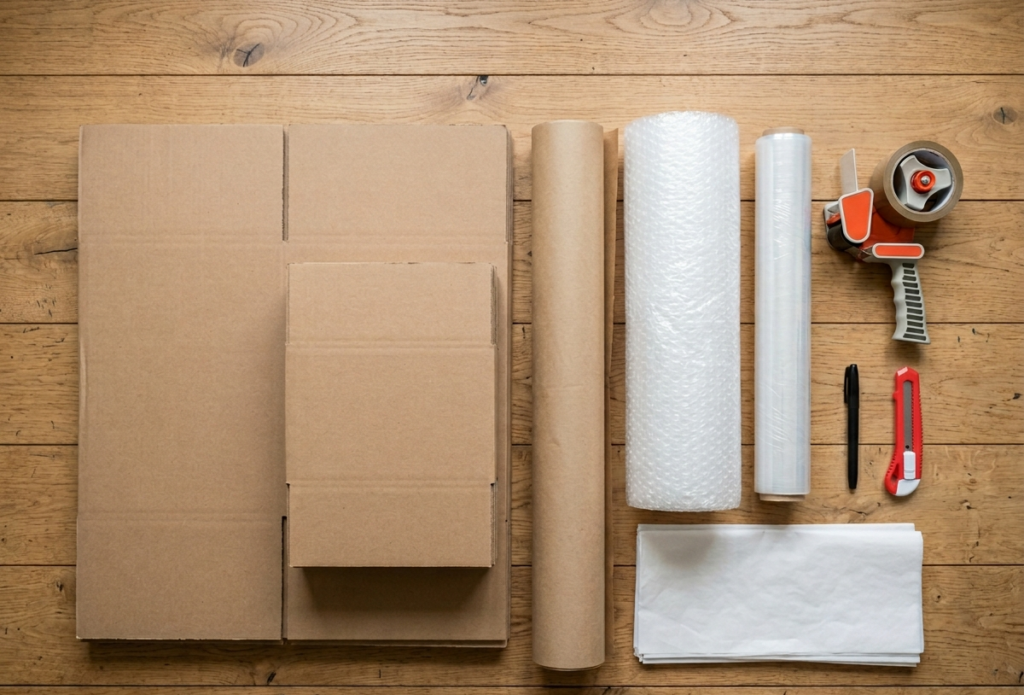
Everything we pack goes into double-walled cardboard boxes rated for stacking. Three sizes, picked based on the contents. Small boxes for dense items like books and paperwork (because anything larger becomes impossible to lift). Medium boxes for general household items. Large boxes for light bulky things like duvets and cushions. Wardrobe boxes with hanging rails for clothes that shouldn’t fold.
Inside the box: acid-free tissue paper for anything that might scratch (china, glass, polished wood items). Bubble wrap for anything that might shatter. Brown kraft paper for cushioning and void-fill. Nothing ever packed with newspaper, because the ink transfers and the fibres attract moisture over time.
Outside the box: pressure-sensitive packing tape, two strips across each seam. Labelled on two sides with room and contents. Fragile items tagged in red marker across the top. Heavy boxes tagged with weight so the crew knows what they’re lifting.
How We Handle Different Categories
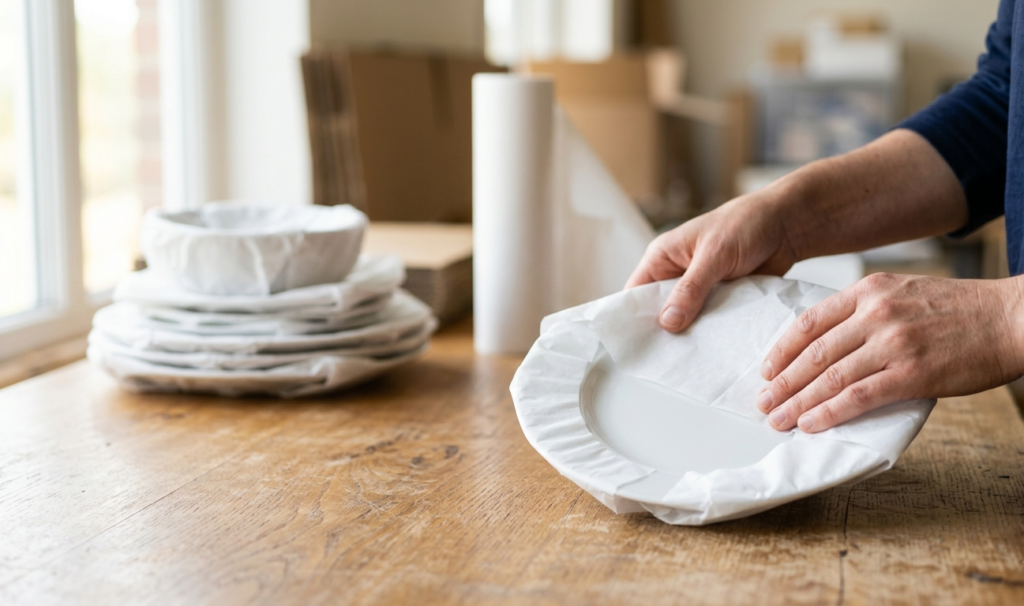
China, Porcelain, and Dinnerware: Each piece wrapped individually in acid-free tissue, not sharing a single sheet with anything else. Plates stacked vertically in the box, not horizontally, because vertical plates survive pressure from above much better than horizontal ones. Cups packed rim-up with the handles nested inward and paper inside the cup to hold the shape. Every box full to the top so items can’t move in transit. Marked fragile in three places.
Glassware and Crystal: Stemware wrapped stem-and-bowl separately in tissue, then bubble-wrapped around the outside. Stored in the box upright, divided by cardboard partitions when we have them for the shape. Decanters and vases bubble-wrapped, packed in boxes small enough that nothing sits above them. Crystal heirlooms photographed before packing on request, so you have a record of condition.
Artwork, Mirrors, and Framed Pictures: Glass frames get taped in a large X across the front before wrapping, so if the glass ever cracks in transit it stays in one piece rather than splintering. Wrapped first in acid-free tissue to protect the surface, then bubble-wrapped, then placed in a flat picture box. Stored upright in the van, never flat. Oil paintings on canvas without glass are wrapped in acid-free tissue only, never bubble wrap, because the plastic can mark the surface.
Electronics and Screens: If you still have the original box from when you bought it, we’ll use that (nothing was ever packed as well as the factory packed it). If not, we wrap in anti-static foam for the shell, then bubble wrap, then in a tight-fitting box with no room to shift. Screens and TVs go in flat-screen boxes and are transported on their side like a book, never laid flat. Cables coiled and labelled with which device they belong to so reconnection at the other end takes minutes rather than hours.
Clothing and Soft Furnishings: Clothes on hangers go straight into wardrobe boxes with integrated hanging rails, the same wardrobe boxes used by international relocation firms. Folded clothing goes in large boxes, loose rather than vacuum-packed, because vacuum packing creases delicate fabrics. Shoes packed in pairs in their original shoeboxes where possible. Bedding and towels packed loose in large boxes as padding for other items.
Books and Paperwork: Books packed flat in small boxes only, never large boxes, because a large box of books is impossible to lift. Spines facing upward so the pages don’t shift. Documents packed in folder boxes with the contents list written on the outside. Archive boxes for long-term storage items, tape-sealed on all seams.
Kitchen Items: Pots and pans stacked with paper between them. Knives wrapped in layers of paper with the blades clearly visible for the person unpacking. Small appliances (kettles, toasters, coffee machines) emptied and wrapped in their own tissue. Spices and opened food sealed in ziplock bags before being boxed. Perishables never boxed, they travel separately or get left behind.
Unpacking
Packing is half the job. Unpacking at the other end is the half that gets forgotten. Most customers arrive at the new property, stack the boxes in the right rooms, and then spend the next two weekends gradually working through them while trying to also live in the space. If that sounds like the last thing you want to do, unpacking is a service you can book alongside packing.
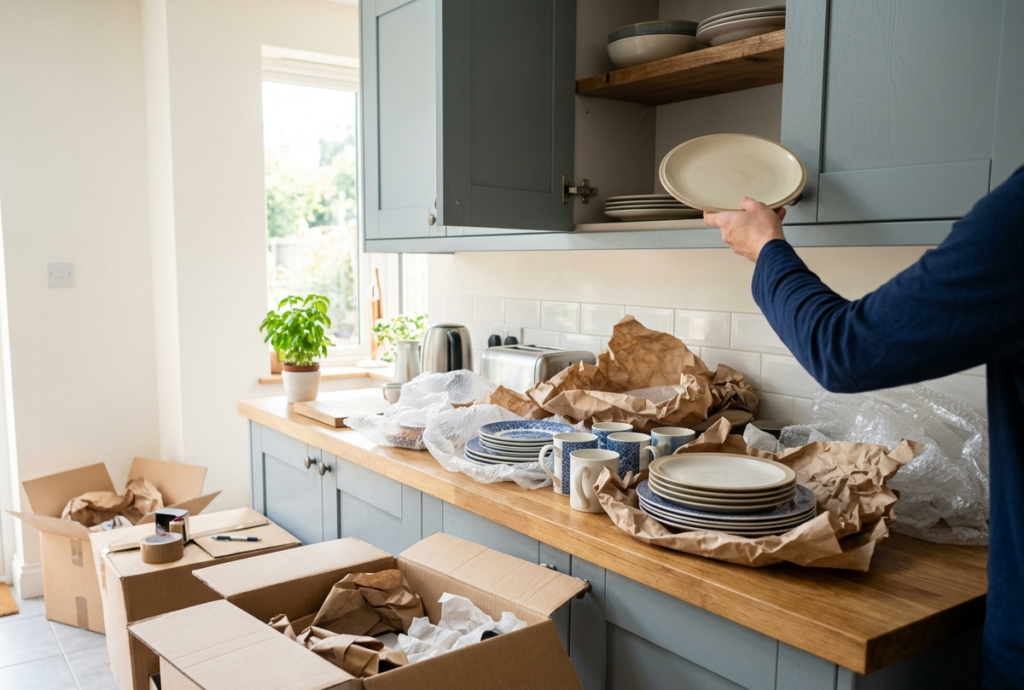
Our unpacking service means our crew stays at the new property until the essentials are out of boxes and in place. Kitchen set up, dinner plates on shelves, glasses in cupboards, pots and pans in drawers. Bedrooms made up, clothes hung in wardrobes, bedding on the beds. Bathrooms stocked, toiletries out. Living spaces furnished and functional. By the time we leave, you’re not living out of boxes.
We don’t unpack every last thing. Decorative items, paperwork, and personal effects stay boxed unless you specifically ask. The goal is ‘functional house’ by end of unload, not ‘finished house’. Finishing it the way you want it is the bit you’ll enjoy doing yourself over the following weekends.
All empty boxes and used packing materials are removed from the property when we leave. Most are re-used on the next job. Nothing ends up in your kerbside bin.
Packing FAQs
How many days before the move should packing happen?
Full-home packs usually happen the day before the move. That way everything is ready, nothing gets unpacked overnight, and moving day becomes just a transport job. For multi-day packs of larger houses, we start two or three days ahead and work room by room, leaving the kitchen and bedroom for the last day so you can still live normally while we work.
Are there things you won’t pack?
A few. Perishable food, open liquids, gas canisters, petrol, paints over a certain quantity, anything flammable or pressurised. Some insurance policies also exclude very high-value items (jewellery over a certain threshold, cash, important documents). For those, we recommend you pack them separately and carry them in your own car rather than trust them to the van.
What if something gets damaged despite being properly packed?
Every box we pack is covered under our goods-in-transit insurance for the move itself. If a professionally-packed box arrives with damage, the claim is straightforward because the packing standard is documented. If a box you packed yourself arrives damaged, the insurance is usually limited or excluded, which is another reason full-home packing often pays for itself.
Do you supply the boxes in advance?
? You can. If you want to pack some items yourself ahead of the move, we can drop off empty double-walled boxes, paper, and tape a week before. You pack what you want to pack, we pack the rest on the packing day. This is a popular option because it lets you control the timing for things you’re sentimental about while handing off the bulk.
Add Packing to Your Move
Tell us the property size and which packing tier you’re after. We’ll come back with a quote that covers materials, crew time, and (if you want it) unpacking at the other end.